





The dog training collar market online today is overwhelmingly American in origin and framing. Search results, casual product reviews, and even most popular buying guides reference AKC competition rules, US state laws, and brands that never shipped to Australia in the first place. Meanwhile, Australian law on this exact category has been changing fast and continuously, and most of that meaningful change hasn't made it into the advice most dog owners are actually reading day to day.
This guide covers the current legal status of every major training collar type in every Australian state and territory, including prong collar bans that came into force as recently as this year, the precise dollar value those penalties represent at current 2026 rates, the structural difference between a martingale and a slip chain that determines how each one actually behaves on a dog's neck, where the Australian Veterinary Association and RSPCA stand on aversive training tools, what to do if you already own gear that's now restricted where you live, and the Rogue Royalty training collar range built around what is actually legal and recommended in Australia today.
Prong Collars: Now Banned Across Most of Australia
This is the area where the law has moved fastest of all, and where most existing online guides are already substantially out of date. Prong collars, metal collars with inward-facing prongs that pinch the skin when tightened, are now prohibited in three of Australia's largest states.
Queensland prohibits both possession and use of prong collars under the Animal Care and Protection Act 2001. Penalties reach approximately $5,007 for possession and $16,690 for use. Victoria prohibits pronged collars outright under the Prevention of Cruelty to Animals Regulations, with a penalty of 15 penalty units, which converts to approximately $3,136 at the current 2026-27 Victorian penalty unit value of $209.10. New South Wales passed legislation making prong collar possession and use an offence, with maximum penalties of 400 penalty units or 1 year imprisonment for an individual, among the most serious penalties attached to any pet equipment regulation in the country.
Penalty unit values are reviewed and adjusted annually in most states, which means the exact dollar figures for any specific offence shift slightly year to year even where the underlying penalty unit count stays fixed in the legislation itself. Checking the current penalty unit value for your specific state through the relevant state treasury or attorney-general's department gives the most accurate current dollar figure rather than relying on a fixed number that may already be a year or more out of date.
Beyond state law, prong collars are illegal to import into Australia at all under the Customs (Prohibited Imports) Regulations 1956, a Commonwealth regulation, without specific permission granted by the Federal Minister for Home Affairs. This means even in a state without an explicit possession ban, legally acquiring a new prong collar through standard import or retail channels is restricted at the federal border.
Electronic Collars: A Genuine Postcode Lottery
Electronic training collars have the most fragmented and inconsistent legal status of any tool in this category, varying completely by state with no national consistency.
| State / Territory | Electronic Collar Status | Key Detail |
|---|---|---|
| NSW | Prohibited | Prevention of Cruelty to Animals Act prohibits possession, sale, and use, with limited exemptions for boundary systems |
| Victoria | Permitted with conditions | Must be an authorised collar; dog must be over 6 months; vet assessment required; max 12 hours wear per 24 hours |
| Queensland | Permitted | No current state prohibition |
| South Australia | Prohibited | Animal Welfare Act prohibits use of an electric device to confine or control an animal |
| Western Australia | Permitted with defence provision | General prohibition exists but a specific defence allows electric training collar use on dogs |
| Tasmania | Permitted with restrictions | Prohibited specifically in connection with sport or public performance training |
| Northern Territory | Permitted with conditions | Excludes collars operated by remote control specifically |
| ACT | Prohibited | Animal Welfare Act prohibits administering electric shock or placing an electric shock device on an animal |
This means a collar that is entirely legal to use in Brisbane could be a prosecutable offence to even possess in Sydney or Adelaide. Anyone considering an electronic collar, including anti-bark and containment fence systems, needs to verify the current regulation in their specific state directly with the relevant government department before purchase, since assuming a product available for sale online is automatically legal to use in your location is a genuine risk in this particular category.
The Victorian conditions deserve closer attention, since "permitted with conditions" understates how specific the requirements are. An authorised electronic collar in Victoria is not simply any commercially available remote training collar; it must meet design and technical specifications approved by the relevant Minister and published in the Government Gazette. Beyond the collar itself meeting this standard, use requires a veterinary practitioner to have examined the dog's physical health and temperament and reasonably believe the dog is suitable for the collar, the dog must be over 6 months of age, the collar must never be left on for more than 12 hours in any 24-hour period, and the dog must be introduced to the collar through a training program that complies with the Victorian Code of Practice for the Training of Dogs and Cats to Wear Electronic Collars. This is a meaningfully higher bar than simply buying a collar online and beginning to use it, and a Victorian owner who skips the veterinary assessment or training program compliance step is operating outside the legal exemption even though electronic collars are broadly permitted in the state.
What the AVA and RSPCA Actually Say
The Australian Veterinary Association's policy position states plainly that collars designed to inflict pain, discomfort, or fear to change a dog's behaviour should not be used, and the AVA specifically recommends prohibition of prong collars across all jurisdictions due to their highly aversive nature. This professional veterinary position predates and aligns directly with the legislative bans now in place in NSW, Victoria, and Queensland.
The RSPCA's stated position opposes any electronically activated device delivering shocks or other aversive stimuli, framing such devices as inflicting pain, fear, and discomfort regardless of training intent. Both organisations consistently direct owners toward reward-based training methods as the preferred approach, with tools like martingale collars and front-attach harnesses positioned as security and management aids rather than correction devices.
This guidance matters beyond the strictly legal question. Even in states where a prong or electronic collar remains technically legal, the leading veterinary and welfare bodies in the country have published clear positions against routine use of these tools by pet owners, reserving any consideration of aversive equipment for cases working directly with certified professional trainers under specific welfare safeguards.
Martingale vs Slip Chain: The Mechanical Difference That Determines Risk
These two tools get confused constantly, and the confusion matters because the actual mechanism behind each one produces meaningfully different risk profiles.
A martingale collar uses two loops: a fixed-size primary loop around the neck and a smaller secondary loop, often a short length of chain or fabric, that tightens when leash tension is applied. Critically, the secondary loop has a built-in limit. Once it closes to its design size, the collar stops tightening regardless of how much further tension is applied. This capped mechanism is what makes a martingale meaningfully safer than a full slip collar for routine use.
A slip chain, sometimes called a choke chain, is a single continuous loop with no built-in stopping point. As long as tension is applied, the loop can continue to tighten. Whether this remains safe depends entirely on the handler's technique: correct fitment high on the neck just behind the ears, brief and well-timed tension, and immediate release the moment the dog responds correctly. A slip chain fitted low on the neck, left under sustained tension, or used by a handler without precise timing carries genuine injury risk, including the soft tissue trauma and increased intraocular pressure documented in veterinary literature on this category of tool.
How to Fit a Martingale or Slip Collar Correctly
Correct fitment is not optional detail; it is the difference between a functional training tool and a genuine safety hazard. Both martingale and slip-style collars must sit high on the neck, directly behind the ears, never down at the base of the neck near the shoulders. A collar sitting low has no meaningful training value and significantly increases injury risk if pressure is applied, since the lower neck and trachea are far more vulnerable to sustained pressure than the area directly behind the skull.
For a martingale specifically, the collar should sit loosely enough that it can slide over the head when fully open, but the secondary loop should close to a snug, non-restrictive fit, not a tight one, once tension is applied. If the martingale closes to the point where it visibly compresses the neck under light tension, the collar is sized incorrectly and should be adjusted or exchanged for a different size.
For a slip chain, correct sizing means the chain sits with minimal slack when loose, just enough to release fully the instant tension stops. A chain with excessive slack delays the release signal the dog needs to learn from, while a chain too tight to release fully defeats the entire mechanism the tool depends on for safe use.
What If You Already Own Gear That's Now Restricted Where You Live
This is a practical scenario the legal guidance rarely addresses directly: an owner who bought a prong or electronic collar legally in one state, or before a ban came into effect, and now either lives somewhere the tool is prohibited or has moved interstate to a stricter jurisdiction. The plain answer is that possession bans generally apply regardless of when or where the item was originally purchased. A prong collar bought legally in Queensland five years ago does not become exempt from the NSW possession offence simply because it predates the legislation; once you are in a jurisdiction where possession itself is the offence, the collar's purchase history is not a defence.
For owners in this position, the practical path is simple: stop using the restricted item, and either dispose of it responsibly or store it somewhere outside the jurisdiction where it remains legal if that actually matters to you, such as a property in a different state. For most owners, the more useful move is simply replacing the tool with one of the permitted alternatives covered in this guide, since continuing to manage legal risk around an outdated piece of equipment is rarely worth it when a martingale collar or front-clip harness achieves comparable practical outcomes for the vast majority of training and management situations.
The Rogue Royalty Training Collar Range
Three products in the Rogue Royalty training collar range sit within the categories currently permitted across Australian states, distinct from prong and most electronic collar configurations now restricted or banned.
Martingale Collar
For: sighthounds, escape-prone dogs, most everyday training and management needs
The standard recommendation for dogs that back out of flat collars, with the limited-slip mechanism that caps tightening at a fixed point. Appropriate for daily wear, unlike full slip chains or aversive tools, since the capped design does not carry the same sustained-pressure risk.
From $55.00 | View the Martingale Collar
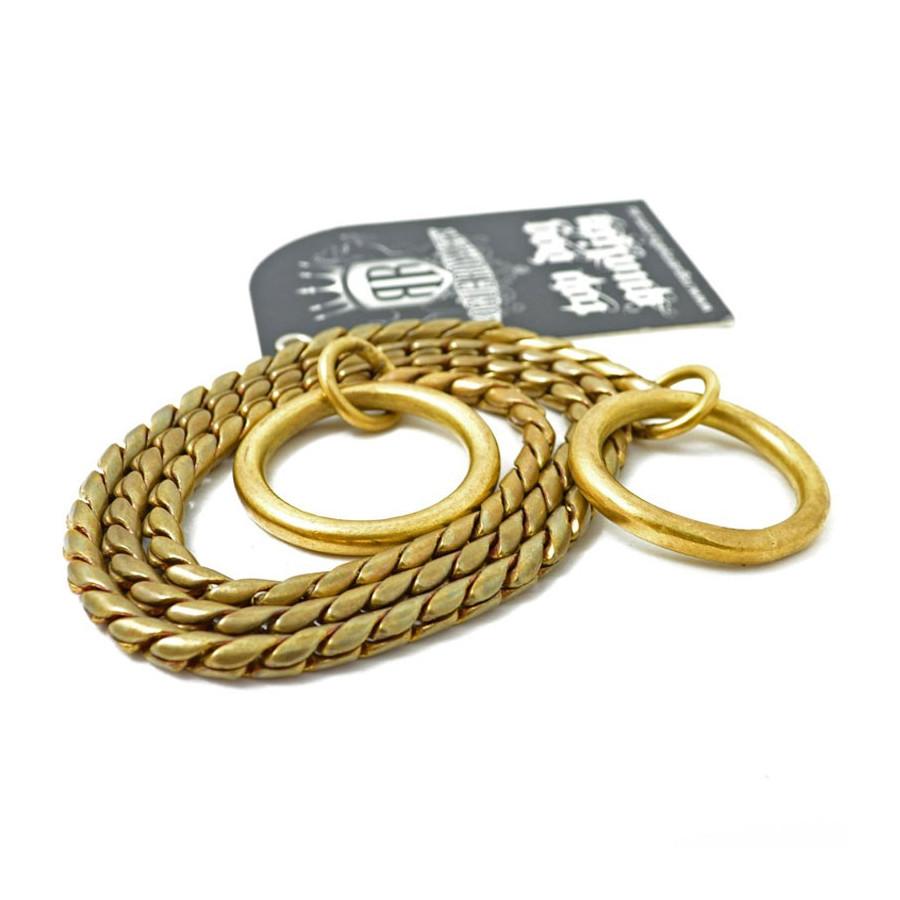
Brass Slip Chain
For: experienced handlers, obedience and working dog contexts requiring precise correction-and-release timing
Solid non-rust brass chain, smooth round-finish links, available in lengths from 40cm to 80cm. Requires correct high-neck fitment and consistent, well-timed handling. Should never be left on an unsupervised dog and is not intended for routine all-day wear.
From $60.00 | View the Brass Slip Chain
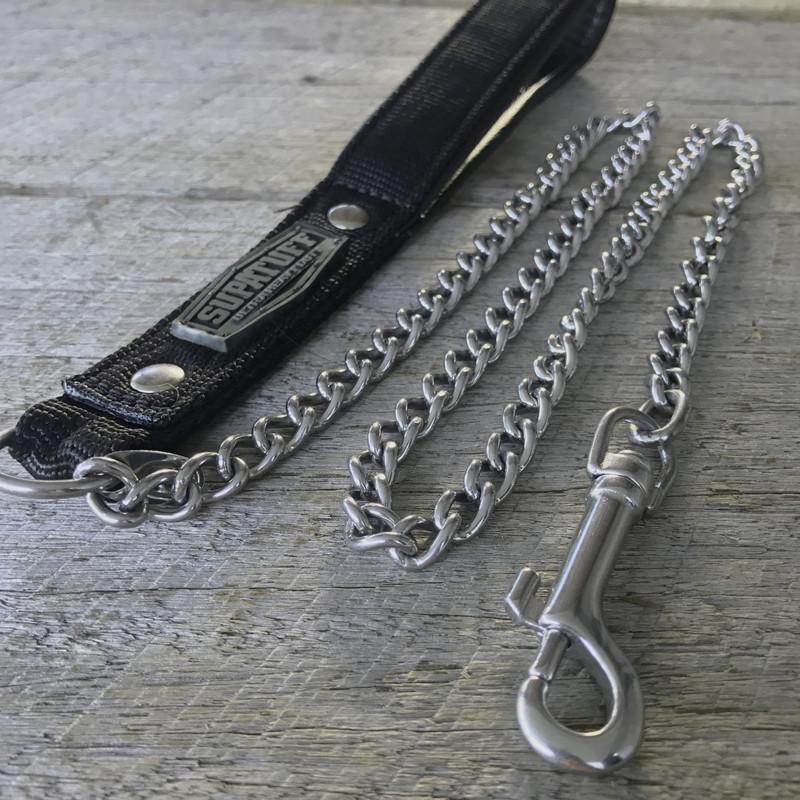
Titan Ultra Heavy Chain
For: large, powerful working breeds requiring greater tactile presence
Hand-welded solid stainless steel heavy links with a chrome coating, approximately 700-800 grams per piece. Sized from 55cm through 90cm by neck circumference. Designed for experienced working dog handlers; same correct high-neck fitment and supervision requirements apply as with any slip-style collar.
$110.00 | View the Titan Ultra Heavy Chain
What to Use Instead, If You Want to Avoid Neck Pressure Entirely
For owners who want to avoid any tool that applies any pressure to the neck whatsoever, even the capped pressure of a martingale, a front-clip harness redirects leash tension to the chest rather than the neck entirely. This is consistent with the direction Australian veterinary and welfare guidance has been pushing for years, and it pairs naturally with reward-based training methods that don't rely on a correction-and-release mechanism at all.
The Rogue Royalty harness range covers this use case directly, with options built for everyday walking control through to heavy-duty management of large, strong dogs, all without any neck-based correction mechanism involved.
Martingale, brass slip chain, and Titan stainless steel chain, all within the categories currently permitted across Australian states. Correct fitment guidance included with every product.
Browse Training Accessories →Checking Your Own State's Current Position
Animal welfare legislation in this category has changed substantially in recent years and continues to be actively reviewed in several jurisdictions, including Western Australia where the Animal Welfare Act 2002 is currently under review. Before purchasing or using any training collar beyond a standard flat collar or martingale, confirm the current regulation in your specific state directly through your state or territory government's animal welfare department, rather than relying on a product listing, a forum post, or a guide that may not reflect the most recent legislative changes. This is particularly important for anyone who has moved interstate recently, since equipment that was entirely legal in a previous state of residence may not be in a new one.
Frequently Asked Questions About Dog Training Collars in Australia
Are prong collars legal in Australia?
No, not in most states. Queensland and Victoria prohibit both possession and use under their respective animal welfare acts. NSW passed legislation in 2026 making possession or use an offence, with penalties up to 400 penalty units or 1 year imprisonment for an individual. Prong collars are also illegal to import into Australia under federal Customs regulations without specific ministerial permission. Always verify current regulations in your specific state.
Are electronic shock collars legal in Australia?
It depends entirely on the state. Prohibited in the ACT, NSW, and South Australia. Permitted with conditions in Victoria, Queensland, the Northern Territory, Tasmania, and Western Australia, though Victoria requires an authorised collar, a dog over 6 months, veterinary assessment, and a maximum 12-hour wear period per 24 hours. A collar legal in one state can be a criminal offence to possess in another.
What is the difference between a martingale collar and a slip chain?
A martingale has a fixed primary loop and a smaller secondary loop that tightens only to a preset limit, then stops. A slip chain is a single continuous loop with no built-in limit and can keep tightening as long as tension is applied. This is why martingales are generally considered lower risk: the design itself caps constriction regardless of handler timing, while a slip chain's safety depends entirely on correct technique.
What does the Australian Veterinary Association say about training collars that apply neck pressure?
The AVA's policy states collars designed to inflict pain, discomfort, or fear should not be used, and specifically recommends prong collars be prohibited across all jurisdictions. The AVA's broader guidance favours reward-based training over aversive tools, aligning with the direction Australian state legislation has taken with prong collar bans and electronic collar restrictions.
Why do sighthounds specifically need a martingale collar?
Sighthounds including Greyhounds, Whippets, Salukis, and Borzois have a head circumference close to or narrower than their neck due to their narrow skull shape, meaning a standard flat collar can slip over the head when the dog pulls backward. A martingale's secondary loop tightens just enough to prevent this, then stops at its built-in limit, securing the dog without unlimited constriction.
Can a slip chain be used safely if a handler knows what they are doing?
An experienced handler with correct technique, proper high-neck fitment, and immediate release carries lower risk than incorrect use, but veterinary and welfare organisations recommend against routine use by most pet owners, since consistent correct timing is notoriously difficult to execute and poor technique carries documented injury risk. For most owners, a martingale collar or front-attach harness achieves similar control with substantially lower risk.
What training collars does Rogue Royalty sell and how do they fit current Australian regulations?
The range covers a martingale collar, a solid brass slip chain, and the Titan Ultra Heavy stainless steel chain, all falling into categories permitted across Australian states, unlike prong collars and most electronic collar configurations. The martingale suits most dogs and sighthounds specifically. The brass slip chain and Titan chain are positioned for experienced handlers requiring correct high-neck fitment and supervision, consistent with AVA and RSPCA guidance.

